

Why Drilling Stability Matters More Than Penetration Rate
- Date:2026-01-20
- Share with:
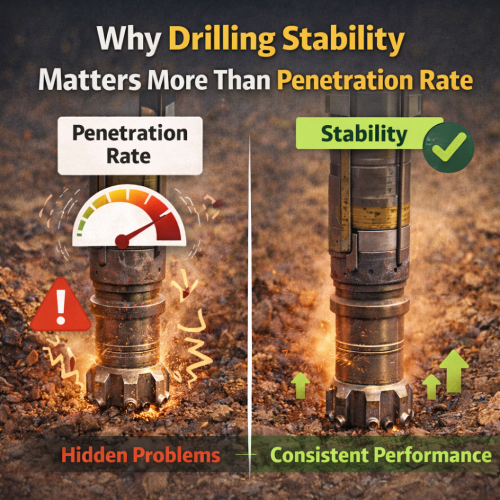
In many drilling projects, performance is often judged by a single metric: penetration rate.
Faster drilling is commonly assumed to mean higher productivity and lower cost.
However, experienced drilling engineers know that penetration rate alone does not represent true drilling efficiency.
In real drilling conditions, instability is one of the most common hidden problems. Excessive vibration, inconsistent rotation, or irregular impact energy can lead to premature tool wear, deviation of the hole, unplanned downtime, and frequent bit changes. These issues often cancel out the apparent advantage of high penetration speed.
Drilling stability plays a critical role in maintaining consistent energy transfer from the hammer to the bit and from the bit to the rock. Stable drilling reduces abnormal stress on drilling tools, improves bit life, and helps maintain straight and predictable holes. Over the course of a project, this stability translates into fewer interruptions, lower maintenance requirements, and more predictable operating costs.
The reason stability is often overlooked is simple: it is harder to measure. Penetration rate is immediately visible, while stability reveals its value over time through tool longevity, reduced failures, and smoother operations.
From an engineering perspective, productivity is not defined by how fast the drill advances in a short interval, but by how consistently the system performs over the entire drilling cycle. In many cases, prioritizing drilling stability delivers better overall results than chasing maximum penetration rate.